
Fire Ant Control Options
If fire ants keep showing up in your yard, pasture or commercial property, it is easy to feel like you are fighting the same battle over and over. Understanding your fire ant control options can make the process less frustrating. Some methods are designed for individual mounds, while others address colonies across a much larger area. The right approach depends on the size of the property, the amount of fire ant activity and whether you are looking for short-term relief or an ongoing way to maintain control.
Mound Treatments
Individual mound treatments are one of the first options many property owners try. These products are applied directly to a visible nest and may come in the form of granules, dusts, drenches or other formulations.
Mound treatment can make sense when there are only one or two isolated colonies. The drawback is that you have to find the colony before you can treat it.
That sounds simple until you consider how much of a fire ant nest is hidden underground. Some colonies are easy to spot because they produce noticeable piles of loose soil. Others are much less obvious. On a larger property, treating only the mounds you see can leave plenty of fire ant activity untouched.
Contact Sprays and Insecticides
Contact products work by affecting ants that come into direct contact with the treatment. They can provide a relatively quick response when fire ants are active in a specific location.
The limitation is right in the name: contact.
Fire ants spend much of their time underground, and the queen remains protected within the colony. Treating worker ants that happen to be above ground does not necessarily address the source of the colony’s continued growth.
For recurring problems, a treatment that can reach deeper into the colony may be a better fit.
Granular Fire Ant Bait
Bait works very differently from a contact spray.
Instead of trying to reach ants underground with an application, bait takes advantage of their normal feeding habits. Foraging workers leave the colony searching for food. When they encounter an attractive granular bait, they pick it up and carry it back to the nest.
The bait can then be distributed throughout the colony.
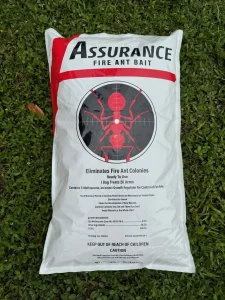
Fire Ant Control uses a queen-targeting granular bait containing an insect growth regulator. Worker ants carry the bait underground, where it eventually reaches the queen. The active ingredient interferes with her reproductive cycle. As existing workers naturally age out without being replaced at the same rate, the colony gradually declines.
The process is intentionally not immediate. Workers need enough time to forage, collect the bait and bring it back before its effects take place.
Broadcast Treatment for Larger Areas
When fire ants are scattered throughout a lawn, acreage, pasture, golf course, athletic field or commercial property, walking around searching for individual mounds can become impractical.
Broadcast treatment approaches the problem differently.
A measured amount of granular bait is distributed throughout the treatment area. Fire ants do not have to be sitting on top of a visible mound to encounter it. Workers naturally forage across the property and can pick up bait as they move.
This can be particularly helpful when multiple colonies are present or when some nests are difficult to locate.
Uniform coverage matters. More bait is not necessarily better. The objective is to distribute the appropriate amount across the areas where workers are likely to forage.
DIY or Professional Fire Ant Treatment?
Homeowners can purchase fire ant products and apply them themselves. For a small yard with limited activity, DIY treatment may be manageable.
The equation changes when you are dealing with several acres, repeated infestations or areas where people and animals frequently spend time.
Professional fire ant treatment can take the guesswork out of choosing an application rate, covering the property evenly and determining when conditions are appropriate for baiting. It also provides a consistent treatment schedule rather than relying on someone noticing a new mound before taking action.
Why Recurring Treatment Matters
No treatment can create a permanent barrier around your property.
Even when existing colonies are successfully controlled, new queens can fly into the area and establish another colony. Fire ants may also migrate from neighboring properties.
That is why Fire Ant Control emphasizes recurring treatment. Maintaining control is easier when new activity is addressed regularly rather than waiting until the property is once again covered with visible mounds.
Treatment timing matters as well. Bait performs best when fire ants are actively foraging and conditions allow workers to find and collect it.
There are plenty of fire ant control options, but they do not all approach the problem in the same way. Mound treatments and contact products may address localized activity, while queen-targeting granular bait and broadcast applications offer a way to manage colonies across the broader property.
For professional treatment designed around ongoing fire ant control, contact Fire Ant Control, LLC at 239-312-8200 or online to request service and discuss the right treatment approach for your property.